Standing Seam Metal Roofing in Syracuse, NY
Concealed-fastener standing seam metal roofing for Syracuse institutional and architectural buildings, engineered for snow shedding and thermal movement.
Standing Seam Metal Roofs and Syracuse Snow Load
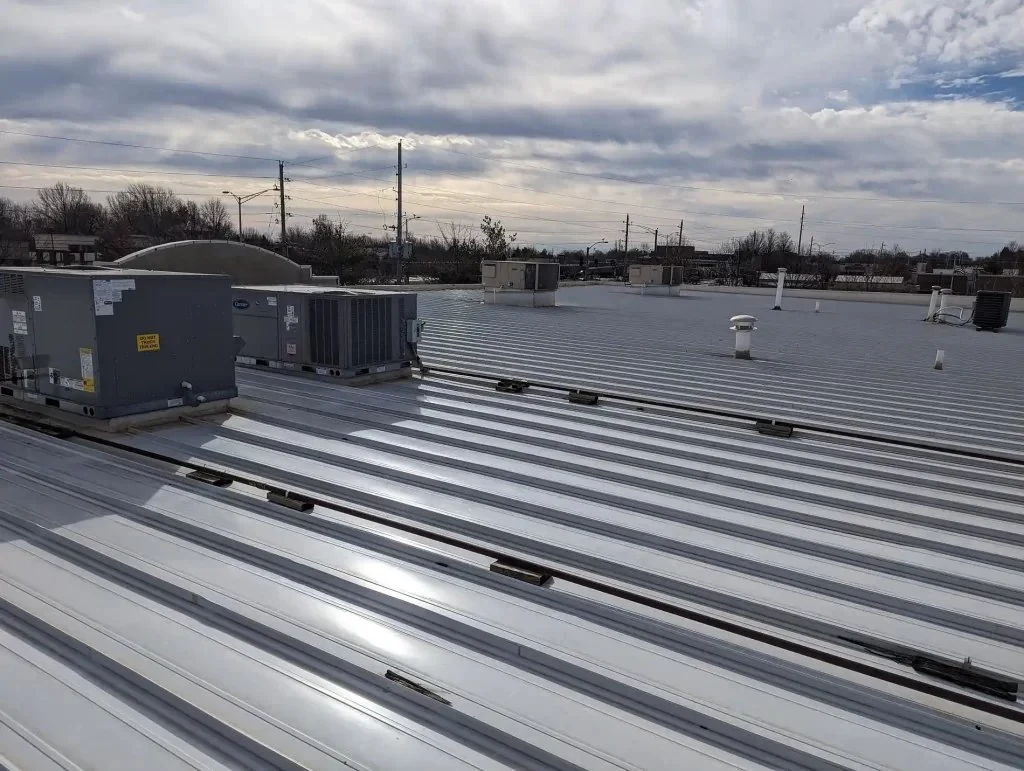
Standing seam metal shows up on steep and moderate-slope sections of institutional and architectural buildings across the area - gable roofs on academic buildings, church-adjacent structures, and newer municipal buildings where the owner wants a fifty-year roof and is willing to pay for it. It sheds snow differently than any flat roof system we install, and that behavior is the whole conversation when we're speccing it for this climate.
Concealed Fastener Systems and Panel Movement
A true standing seam roof uses concealed clips under the raised seam rather than exposed screws through the panel face, which lets the metal expand and contract with temperature swings without stressing a fastener hole. That matters enormously here - a Syracuse roof panel might swing through a temperature range of over a hundred degrees between a summer afternoon and a deep January night, and a fixed fastener through the panel face would eventually work the hole oversized and start leaking.
We size clip spacing and panel width based on that expected thermal movement, not simply wind uplift numbers. Wider panels move more per linear foot of temperature change, so panel width selection is partly a cold-climate decision, not purely an aesthetic one.
How Snow Actually Sheds Off These Roofs
Standing seam's smooth panel surface and steeper pitch mean snow releases in sheets rather than melting off gradually the way it does on a flat membrane roof. That's good for keeping snow load off the structure, but it creates a real hazard below - walkways, entrances, parked vehicles, and rooftop equipment on a lower adjacent roof section can all be in the path of a sudden snow slide off a standing seam section.
We plan snow guard placement specifically around where people and equipment are below the roof edge, not as an afterthought. On buildings with entrances or walkways under a standing seam slope, snow guards aren't optional - they're part of a functioning roof design in this climate, the same way gutters are.
Ice Damming at Eaves and Valleys
Even a steep metal roof gets ice damming at the eave line when warm attic air melts snow higher on the roof and it refreezes at the colder eave edge. We look at attic or roof deck insulation and ventilation as part of any standing seam scope, because ice damming here is often a ventilation problem more than a roofing problem - poor attic ventilation lets heat escape unevenly across the roof surface and creates the melt-refreeze cycle that backs ice up under panels at the eave.
Valleys concentrate water and ice flow even more than eaves do, and we detail valley flashing with extra width and ice-and-water membrane underneath specifically because of how much volume funnels through a valley during a rapid thaw.
Panel Profiles and Seam Types
We install both mechanically seamed and snap-lock panel systems depending on the roof's slope and the budget. Mechanically seamed panels, where a seaming machine crimps the panel edges together on site, give a tighter, more weathertight seam and are what we recommend on lower-slope applications or anywhere ponding or standing water risk is higher. Snap-lock panels install faster and cost less but need adequate slope to perform reliably over time.
Details we plan carefully on every standing seam job in this climate:
- Snow guard placement above entrances, walkways, and lower roof sections
- Clip spacing sized for the panel's expected thermal expansion range
- Eave and valley flashing width sized for ice-and-water backup potential
- Attic or deck ventilation adequacy to reduce eave ice damming
- Panel seam type matched to actual roof slope, not simply budget
- Fastener-free field panel design to avoid thermal-cycling leaks
Maintenance on a Metal Roof That Actually Matters
Standing seam roofs need less routine maintenance than membrane systems, but they're not maintenance-free. We check clip and seam condition periodically, especially on older installs where clips may have been under-spaced for the panel's actual thermal movement. We also inspect snow guard attachment points after major snow events, since a heavy slide can put real stress on guard hardware, and a guard that's pulled loose stops doing its job right when it's needed most.
Sealant at penetrations - vents, curbs, any place something breaks the panel field - ages faster than the metal itself and gets checked on every visit, since that's usually where a metal roof actually starts leaking, not through the panels.
Standing Seam Questions
Do I need snow guards on every standing seam roof?
Not every roof, but any section that sheds snow onto a walkway, entrance, parking area, or lower adjacent roof needs them. We assess snow slide paths as part of the design, not as an add-on after installation.
How long does a standing seam metal roof last in this climate?
Well-installed systems with proper clip spacing and finish coatings commonly perform for several decades, with sealant and fastener maintenance at penetrations being the main upkeep item over that span.
Can standing seam be installed on a low-slope roof?
It needs adequate slope to shed water reliably, and we recommend mechanically seamed panels with extra attention to lap and end conditions on anything approaching the lower end of the acceptable slope range.
Why does my metal roof leak at the eave every winter?
Eave leaks during winter are almost always ice damming from attic heat loss, not a panel or seam failure. We check ventilation and insulation as the first step before assuming it's a roofing defect.
Is standing seam worth the added cost over a membrane roof?
On the right building - steep-slope, architecturally visible, long ownership horizon - the service life and low maintenance often justify the higher upfront cost. It's a different value proposition than a flat membrane roof, not a straight upgrade for every building.
Questions About Standing Seam Metal Roofing in Syracuse, NY
Ready to Review the Roof?
Service Area
Syracuse, NY
Roofing Category
Assessment Focus
Condition
Drainage
System options
Occupied operations
Next Step