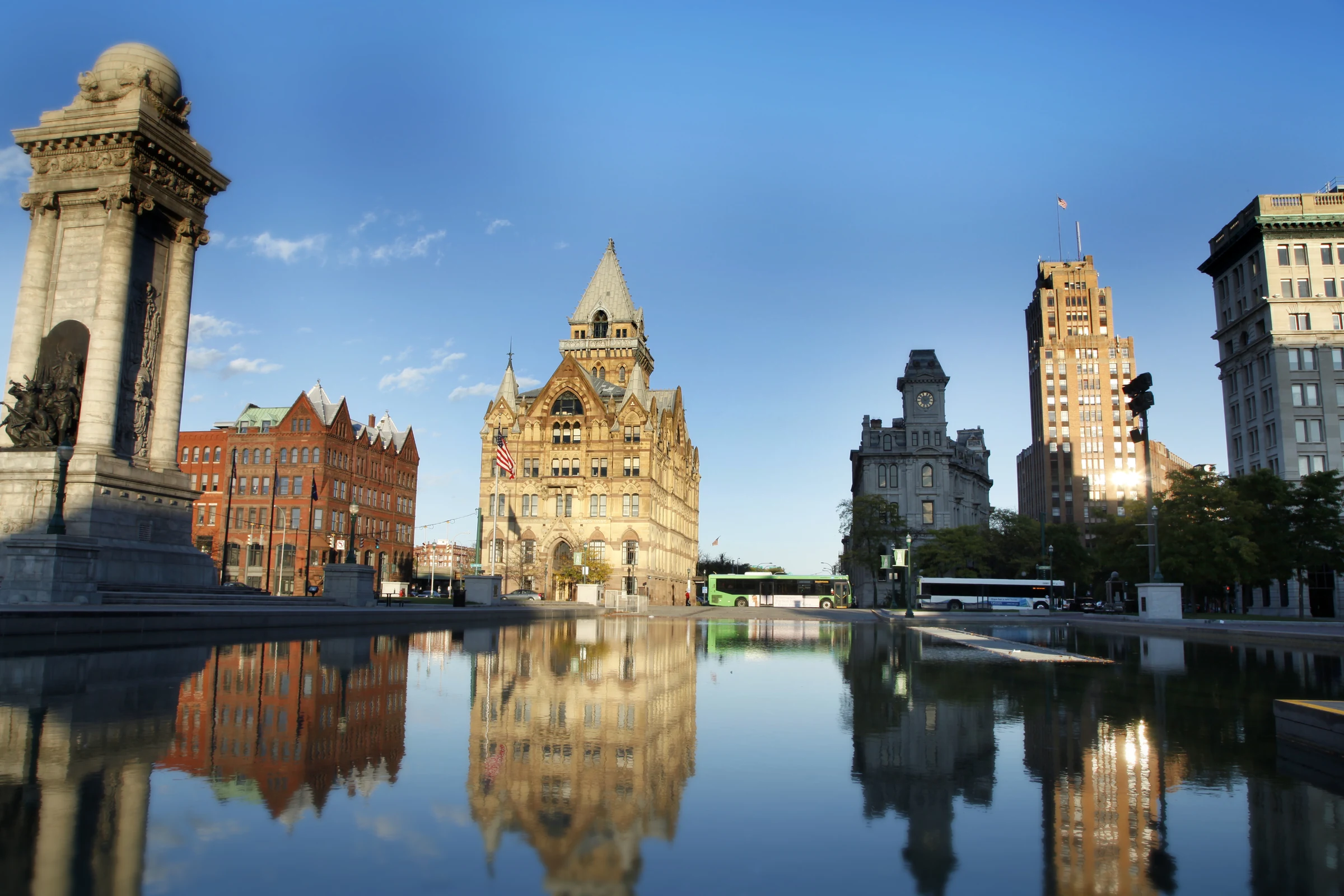
Commercial Roofing Contractors Downtown Syracuse, NY
Commercial roofing contractors serving Downtown Syracuse, NY with commercial roof repair, replacement, coatings, maintenance programs, inspections, and documented roof reports.
Commercial Roofers in Downtown Syracuse
Commercial roofers serving Downtown Syracuse should document leak sources, wet insulation, drainage, edge details, penetrations, and repair history before recommending a scope. Downtown Syracuse packs a dense mix of office towers, hospitals, and hotels into a compact footprint that bumps up against University Hill and the Syracuse University campus. Roofing here means working on occupied high-rises and medical facilities where the building never fully empties out, and access is often the hardest part of the job before the actual roof work even starts.
Office Tower Roofs and Setback Access
Downtown's office towers are not simple single-level flat roofs. Many have setbacks, mechanical penthouses, and multiple roof levels stacked at different elevations, each with its own drainage and membrane condition to track separately. Getting equipment and material to an upper roof level in a downtown high-rise usually means coordinating freight elevator access, tenant notification, and sometimes street closure for a crane or hoist, none of which a suburban flat-roof job requires. We plan the logistics of a downtown tower job as carefully as the roofing scope itself, because a crew that shows up without elevator reservations or street permits loses the whole day before touching the membrane.
Hospital and Medical Facility Roofing
Downtown and the University Hill edge are home to several hospital campuses, and a hospital roof leak is a different category of problem than a leak over office space. Water intrusion near an operating suite, imaging equipment, or a server room supporting patient records can shut down an entire department rather than simply inconvenience a tenant. We plan hospital roof work in coordination with facilities staff around infection control protocols, negative-pressure area requirements, and noise restrictions near patient care areas, and we treat any active leak call at a medical facility as an emergency response, not a scheduled visit.
Hospital roofs also tend to carry a dense field of rooftop equipment: air handlers, exhaust for surgical suites, communications equipment, and backup generator exhaust penetrations. Each one is a potential leak point that needs individual attention during inspection rather than a general walk-through.
Hotel Roofs Serving Downtown and University Traffic
Downtown's hotel stock serves both business travel and the steady flow of visitors connected to Syracuse University and University Hill's medical institutions. These buildings need roof work scheduled around occupancy the same way DeWitt's hotels do, but with the added complexity of downtown noise ordinances and limited staging space on tight urban lots. We often stage materials off-site and bring up only what a crew needs for that day's work when a downtown hotel job does not have room for a full material laydown area.
University Hill's Institutional Roofs
Where downtown meets University Hill, the building stock shifts toward institutional and academic-adjacent construction: research buildings, administrative offices, and mixed-use development that has grown up around the university and its affiliated medical campus. These roofs often carry specialized equipment, lab exhaust, fume hood penetrations, and backup power infrastructure, that requires the same careful, documented approach we use on hospital roofs.
Recurring issues we find across downtown's older institutional and office roof stock:
- Aging built-up and modified bitumen systems on setback roof levels that get inspected less often than the main roof
- Cracked pitch pans around dense clusters of penetrations near mechanical penthouses
- Deteriorated parapet coping on masonry buildings from decades of freeze-thaw exposure
- Undersized scuppers on older buildings not designed for today's rooftop equipment loads
- Flashing failures where newer rooftop equipment was added without proper tie-in to the original membrane
Coordinating With Building Engineers and Facilities Teams
Most downtown buildings of any size carry an in-house facilities or building engineering team, and a roof job that ignores that team is a roof job headed for friction. We loop the building engineer in on scope, timing, and any equipment shutdowns before work starts, since they are the ones fielding tenant questions after we leave for the day and they need to know what changed on their roof. On several downtown towers we service, the facilities team keeps its own equipment log that predates any roofing contractor's involvement, and cross-checking our findings against that log during inspection often turns up a penetration or repair history nobody remembered until we asked.
Winter Access on Urban Roofs
Downtown's density creates its own winter roofing challenge. Snow and ice removal from a setback roof level has to account for what is below, sidewalks, loading docks, sometimes another roof level, so material cannot simply be pushed off the edge the way it might on a standalone suburban building. We plan snow and ice work on downtown roofs with controlled removal and containment, which takes longer than a simple push-off but keeps pedestrians and lower roof areas safe.
Questions From Downtown Building Owners
How do you handle roof access on a high-rise without disrupting tenants?
We coordinate freight elevator time, tenant notification, and any required street permits before the job starts, so access delays do not eat into the working schedule.
Can you respond to an active leak at a hospital facility on short notice?
Yes, we treat hospital leak calls as emergencies given the sensitivity of what is below the roof, and we coordinate with facilities staff on any infection control or access protocols.
What is different about roofing an occupied hotel downtown versus a suburban property?
Limited staging space and stricter noise timing. We often stage materials off-site and bring up only what is needed for that day.
Do you work on research or lab buildings near University Hill?
Yes, including roofs with specialized exhaust and penetration requirements tied to lab and research operations.
How do you remove snow and ice from a setback roof level safely?
We use controlled removal and containment rather than pushing snow off the edge, since setback levels usually have occupied space or pedestrian areas below.
Questions About Commercial Roofing Contractors Downtown Syracuse, NY
Ready to Review the Roof?
Service Area
Syracuse, NY
Roofing Category
Assessment Focus
Condition
Drainage
System options
Occupied operations
Next Step